
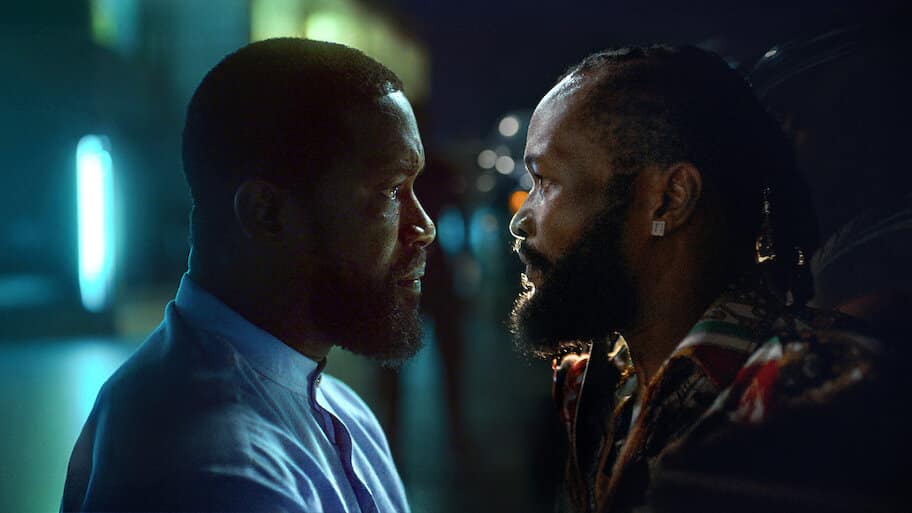
Kemi Adetiba’s To Kill a Monkey is a show defined by a powerful central idea: the moment a desperate man decides to kill his conscience. It’s a series that takes the timely and often sensationalised topic of Nigerian cybercrime, or “yahoo,” and attempts to strip it down to its rawest human components. What emerges is a compelling, if structurally flawed, morality play—a modern-day fable about the crushing weight of ambition and the seductive allure of an illicit escape.
The narrative orbits around Efemini, a talented but perpetually struggling programmer on the brink of financial ruin. His world is a suffocating tapestry of expectations: a family to provide for, triplets on the way, and the looming expenses of a mother’s burial rites. William Benson’s portrayal of Efemini is a masterclass in quiet desperation. He carries the weight of the world on his shoulders, his eyes a constant window into the agonising calculus of a man with too many responsibilities and too few options. His journey is a relatable tragedy, a slow descent into a moral grey area that is less a choice and more a surrender to circumstance.
The series’ true standout character catalyses this surrender: Oboz, a cybercrime kingpin with the magnetism of a cult leader, played with mesmeric menace by Bucci Franklin. Franklin doesn’t just play a villain; he embodies a twisted ideology. Oboz is the charismatic devil on Efemini’s shoulder, a smooth-talking, well-dressed mirror image of the success Efemini craves. His scenes are electric, crackling with a dangerous energy that makes you understand not just why Efemini follows him, but why anyone would. The dynamic between Benson’s grounded despair and Franklin’s intoxicating charm is the show’s primary strength, a high-stakes psychological chess match that keeps you hooked.
Adetiba’s directorial eye is sharp, and her aesthetic is undeniably slick. The cinematography is crisp, and the production design expertly contrasts Efemini’s initial spartan existence with the gaudy, opulent world of Oboz and his ilk. The series’ visual language is confident and stylish, painting a portrait of Lagos that is both sprawling and claustrophobic. The original score, created by Oscar Heman-Ackah, is equally ambitious, a throbbing pulse that underscores the mounting tension and emotional turmoil.
However, for a story so focused on the gritty reality of a criminal enterprise, To Kill a Monkey strangely shies away from showing us that world in action. The biggest narrative flaw is a persistent reliance on exposition over experience. We are told of Oboz’s intricate empire, his network, and his genius, but we are rarely given a chance to witness it. Scenes often devolve into extended conversations and monologues, where characters explain the plot or their motivations rather than demonstrating them through their actions. This decision, perhaps an attempt to focus on the psychological drama, unfortunately deflates the high-stakes crime thriller it purports to be. The supposed ‘grittiness’ of the subject matter is rendered more like a staged play, with actors delivering impactful speeches but operating in a world that feels largely unseen and thus, less real.
This issue extends to the parallel investigation storyline. While the presence of Inspector Mo, a dogged police officer portrayed with quiet authority by Bimbo Akintola, adds a much-needed layer of law enforcement perspective, her narrative feels underdeveloped. It functions more as a plot device to remind us of the legal consequences rather than a compelling, fully-fleshed-out pursuit. The ending, in particular, suffers from this structural weakness. After a slow and deliberate build-up of tension and moral ambiguity, the climax feels rushed and strangely convenient, opting for a tidy resolution that undermines the chaotic and messy reality the series had so effectively explored.
Despite its structural shortcomings, To Kill a Monkey is a significant and important piece of television. It is a show with a clear voice, a bold vision, and a cast that elevates every scene they are in. It may not always succeed in its storytelling, but it never fails to be compelling. It shines a light on the desperate choices born from desperation and forces us to confront a complex reality that is often oversimplified. It’s a series that, much like its protagonist, takes a gamble. While it may not win big, it certainly leaves a lasting impression.



Comments
Sign in to leave a comment.
No comments yet. Be the first to share your thoughts.