

Nonye Jennifer Amaechi on writing as survival, her debut novel Black Ink White Paper, and why love in her fiction is never simple. A Moveee Lane interview.
As a Nigerian woman living in the UK, Nonye Jennifer Amaechi explores what it means to exist in spaces that don’t always make room for you. Her work sits at the intersection of identity, love and power, highlighting the subtle negotiations that come with being seen, heard, and understood on your own terms. In this edition of The Lane, she reflects on writing as a form of survival and building stories that centre emotional truth and cultural nuance, sharing her influences, creative process, and the ideas behind her latest work Black Ink, White Paper — a story that moves between romance and resistance, asking what it truly means to belong.
I started writing at thirteen. At the time, it wasn’t about becoming a writer; it was survival. Writing was my way of releasing emotions I couldn’t share with anyone else. My diary became a silent therapist, one that listened without judgment. I had a difficult childhood, shaped by pain, confusion, and a deep sense of isolation. I was always angry, but I didn’t understand why. People tried to reach me, but I pushed them away because I didn’t even understand myself. Back then, it felt like no one truly saw or understood me, except the pages I wrote on.
As I got older, my loneliness deepened, and so did my writing. This time, my imagination took over. I began creating worlds where I had control, where things made sense, where I could give myself the endings I didn’t have in real life.
The books I grew up reading shaped me just as much as the writing did. I loved romance novels growing up. Completely obsessed, actually. They fuelled a lot of my “delulu” moments. I was so immersed in them that my mum once had to pray and fast for me because she thought I was possessed. It was that serious. Beyond that, I also enjoyed books by African writers like Buchi Emecheta and Chimamanda Ngozi Adichie. Some of my favourites include The Joys of Motherhood, Purple Hibiscus, and The Concubine. The Joys of Motherhood made me weep; I even remember vowing never to get married after reading it.
| Book | Author | Why It Matters |
|---|---|---|
| The Joys of Motherhood | Buchi Emecheta | “Made me weep. I even remember vowing never to get married after reading it.” |
| Purple Hibiscus | Chimamanda Ngozi Adichie | A childhood favourite that showed her African women’s stories could be full and contradictory. |
| The Concubine | Flora Nwapa | Part of the African women’s fiction that taught her to distrust neatness in storytelling. |
| Death of the Author | Nnedi Okorafor | “Because of how it explores the relationship between a writer and their work.” |
| If Beale Street Could Talk | James Baldwin | “For its emotional depth, how it holds love and injustice in the same space.” |
| Don’t Touch My Hair | Emma Dabiri | “Grounds me in cultural and historical awareness, especially as someone living in the diaspora.” |
After I graduated from university in 2021, I came across a post from an online writing platform while scrolling through Facebook. They were looking for fantasy writers, and on impulse, I signed up. I didn’t overthink it. I just thought, stories already live in my head, so why not try? That moment marked the beginning of my writing becoming something more than a private expression.
Even then, something felt incomplete. I wasn’t writing the stories I truly wanted to tell. I wanted my work to reflect real experiences, to speak to people, and engage with society in a meaningful way. That feeling became stronger after I moved abroad. Eventually, I made the decision to go solo. It took me five years to get there, but that choice led to the birth of the Hearts and Skin series, with Black Ink, White Paper as its starting point.
Living in the diaspora has made me more conscious as a writer of identity, voice, and what it means to belong. When you’re outside your home country, you become more aware of how you’re perceived and how you see yourself. That tension naturally finds its way into my writing. I often write characters who are negotiating space, culturally, professionally, and emotionally, because that’s something I deeply understand.
It has also changed how I notice details. Things I once took for granted, language, food, mannerisms, even silence, now feel significant. I find myself preserving those details more intentionally, almost like documenting pieces of home while exploring what it means to evolve beyond it. At the same time, living abroad has expanded my perspective. I’m exposed to different systems and ways of life, which allows me to write stories that exist at the intersection of multiple worlds.
When it comes to how I actually write, I’m what writers call a pantser. I don’t outline. I’ve tried, but it never works for me. My ideas evolve too quickly, and I often wake up with new directions for the story, so following a fixed structure feels restrictive. For me, the writing process begins the moment I have an idea. With Black Ink, White Paper, I was on holiday when inspiration came, and I immediately started writing.
My first drafts are messy. I rewrote the first chapter of BIWP about five times before it felt right. Once my first chapter is in place, everything else becomes easier. It’s like breaking through a mental barrier; the story starts to reveal itself more naturally from there.
| Phase | What Happens |
|---|---|
| Spark | The writing process begins the moment I have an idea. With BIWP, I was on holiday when inspiration came, and I immediately started writing. |
| The First Chapter Battle | My first drafts are messy. I rewrote the first chapter of BIWP about five times before it felt right. Once it’s in place, everything else becomes easier. |
| Slow Drafting | I’m not a fast writer. I take my time because I want the story to feel right, not rushed. BIWP took me a year and five months to complete, excluding editing. |
| Marination | When I finish a draft, I step away from it completely and let it “marinate.” This distance helps me return with clarity, especially because I tend to write emotionally and instinctively. |
| Layered Editing | Coming back with fresh eyes allows me to see what needs refining, what needs more depth, and what needs to shift. After that, I complete a first round of edits, step away again briefly, and then do a final edit. |
| Production | Once I’m satisfied, I send the manuscript to a professional editor. At the same time, I handle other parts of the process: cover design, proofreading, and preparing advance copies for early readers. |
It’s not a linear or perfect process, but it works for me. It’s intuitive, a little chaotic, but ultimately grounded in trusting the story as it unfolds.
Preparation is part of the process too, but I don’t approach research like a checklist. I approach it as if I’m trying to understand a life I haven’t lived yet. I usually begin with the emotional core of the story: what is the character struggling with? Identity, power, belonging, love? Once I understand that, my research becomes more intentional. I’m not just gathering facts. I’m looking for texture: how people speak, the unspoken rules in certain environments, the subtle details that make a story feel real.
For Black Ink, White Paper, I read articles, watched interviews, and observed how people discussed their work online. But I also relied heavily on lived experiences, both mine and others’. Conversations helped, but listening helped even more. I’m careful not to over-research to the point where the story loses its voice. At some point, you have to trust yourself and let the characters breathe. Research should support the story, not suffocate it.
People often ask what draws me to the themes I keep returning to. My work is deeply rooted in identity, power, and the quiet, complicated ways people try to belong, whether in love, society, or within themselves.
I’m drawn to these themes because they shape how we move through the world, often in ways we don’t immediately recognise. Who gets to be heard, who gets to be loved openly, who has to adjust or negotiate their presence? These questions exist beneath everyday interactions, and I’m interested in bringing them to the surface. A lot of it comes from lived experience. Moving through different environments makes you aware of power: who holds it, who doesn’t, and how that imbalance affects even the most intimate relationships. For me, love is never just soft or romantic. It’s layered. It’s influenced by race, class, expectation, and fear. So when I write, I’m not just telling a love story. I’m exploring what it means to love within those realities.
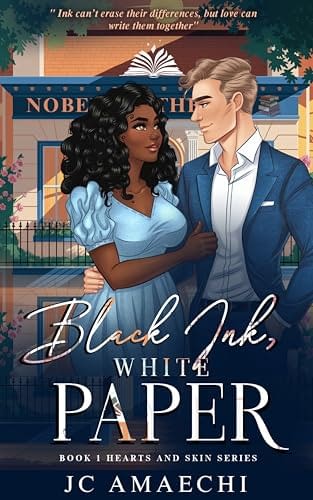
My debut novel, Black Ink, White Paper, is a contemporary romance set in the publishing world. It follows Kambili, a Nigerian woman navigating ambition and identity in London, and her unexpected connection with Taylor, the CEO of a publishing house. Beyond the romance, the story explores race, professionalism, and the subtle ways people are asked to reshape themselves to fit into certain spaces.
My second novel, Bronze Skin, Ivory Heart, set for release next year, continues in that emotional space but expands it. It explores love, identity, and the tensions that come with relationships shaped by culture, expectation, and personal history.
Alongside my novels, I write short stories that allow me to experiment with voice and form. “A Year I Cooked” was published in Brittle Paper’s Christmas anthology. “A Silence of a Crier” is forthcoming in Kalamari Review, and “A Name in the Dark” is a more personal, evolving project. Across all my work, I’m interested in inner lives: the contradictions, vulnerabilities, and quiet moments that shape who we become.
When I think about the role storytelling should play in challenging misconceptions about African societies, I feel strongly about this:
Storytelling has a responsibility not to present Africa in ways that make it digestible to outsiders, but to tell the truth in all its complexity. For too long, African stories have been reduced to narrow narratives. While those realities exist, they are not the whole story. Literature should make space for joy, softness, ambition, romance, and contradiction. It’s about reclaiming authorship, allowing African characters to exist as full, complex people, not stereotypes. Storytelling challenges misconceptions by refusing simplification. It reminds people that African societies are layered, evolving, and deeply human.
Nonye’s Featured Work
Title Format Status Black Ink, White Paper Novel (Hearts and Skin series) Debut Bronze Skin, Ivory Heart Novel (Hearts and Skin series) Set for release in 2027 “A Year I Cooked” Short story Published in Brittle Paper’s Christmas anthology “A Silence of a Crier” Short story Forthcoming in Kalamari Review “A Name in the Dark” Short story Evolving personal project
As for the conversations I hope my work opens up, I want them to be honest, sometimes uncomfortable, the kind people don’t always know how to start. I want conversations about identity, what it means to exist between cultures, and what it costs to constantly edit yourself to belong. I want conversations about love, the complicated kind shaped by power, expectation, and difference. And I want space for quieter conversations too, about grief, silence, family, and the things we carry but don’t say.
Looking ahead, readers can expect me to go deeper emotionally and creatively. Bronze Skin, Ivory Heart will centre Black love more intimately and intentionally, focusing on internal dynamics rather than external validation. I’ll also continue exploring short fiction and building community around my work through conversations, readings, and shared spaces. For me, storytelling doesn’t end with publication. It continues in how people engage with the work.
If you looked at what I’m reading right now, you’d see where my head is at. Death of the Author by Nnedi Okorafor, because of how it explores the relationship between a writer and their work. If Beale Street Could Talk by James Baldwin, for its emotional depth, how it holds love and injustice in the same space. And Don’t Touch My Hair by Emma Dabiri, which grounds me in cultural and historical awareness, especially as someone living in the diaspora. Together, these books reflect the questions I keep returning to in my own writing: identity, voice, and authorship.
More than anything, I want my stories to make people reflect and feel less alone.
So overall, readers can expect more honesty, more intention, and stories that centre on emotional truth. That’s what my diary did for me at thirteen. I’m just building that same space, wider now. And I am not in any rush.
Every creative has a story that brought them here. First-person interviews with creatives across industries. Each issue is in partnership with, and guest-curated by a different organization.
Read the full series →Free · Weekly · Unsubscribe any time

Rapid Fire with Qudrah Adam, the Author Rewriting Muslim Woman


Comments
No comments yet — be the first to share your thoughts.